Sunday, April 29, 2007

Alice Enters Her Cocoon

Tully Hall to undergo transformation
Sunday, April 29, 2007
Image courtesy of Lincoln Center.
By EVELYN SHIH
STAFF WRITER


Monday, for the first time ever, cocktails will be served in the auditorium of Lincoln Center's Alice Tully Hall.

No one is likely to mind a little splash and spill. After the post-cocktail "Good Night Alice" gala concert, the hall will be closed for an 18-month renovation. Lincoln Center authorities say that the concert hall, which houses an average of 750 events per year, will have upgraded amenities as well as a transformed interior and exterior.

"It will come out more svelte, more contemporary, more beautiful," said Lincoln Center Festival director Nigel Redden, who designed the "Good Night Alice" program.

The program, hosted by Tom Brokaw, will be broadcast Thursday on PBS for those of us who can't afford to drop $1,500. "It will be a look at the last 40 years of Tully Hall, and what has come of it," said Redden. "Over the years, it has become a jumping-off place for so many top performers."
Among others, soprano Renee Fleming and violinist Joshua Bell have made their New York debuts at Tully, which has also played host to events that have featured such headliners as Yo-Yo Ma, Spike Lee and Rosie O'Donnell.

Lincoln Center's Chamber Music Society, housed at the hall since its inception, will appear on the gala program, as will Wynton Marsalis, who represents Jazz at the Lincoln Center -- another initiative begun at Tully. In addition, Broadway star Audra McDonald will sing from the American Songbook, and composer Philip Glass will perform to a visual presentation of plans for the future Alice Tully Hall.
Redden, who knew Alice Tully personally, claims a "somewhat selfish" impulse to celebrate Tully as a one-of-a-kind lady in addition to celebrating the hall as an institution.

"I'm not sure she would have been totally pleased [with the renovation plans]," he said. "She was very much of her time."

"Miss Tully," as Redden knew her, was passionate about the tiniest details of the music hall that was built in her name. A tall woman, she famously insisted on the distance between the rows of seats. She chose the wood that would be used in construction -- and decorated the ladies room with animal print.

The comfortable spacing in the audience seating will be preserved, said Redden, but "I think the wallpaper will be changed."

Yet perhaps Tully, who passed away in 1993, would forgive the Lincoln Center directors for their modifications to her original design. "She would be pleased that the hall will be as up to date now as it was when it was first built, with the most modern acoustics and very much a contemporary statement as a music hall," said Redden.

"It will always be an exciting place for young musicians to play," he added. "I think she would be willing to let go of the wallpaper for that."

E-mail: shih@northjersey.com

Copyright © 2007 North Jersey Media Group Inc.

Friday, April 27, 2007

Be the Dance

Monks serve as ambassadors of spirituality, peace
Friday, April 27, 2007
Image courtesy of buddhistchannel.tv

By EVELYN SHIH
STAFF WRITER

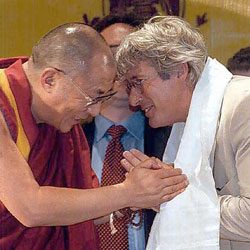
This Sunday, prepare yourself for a religious experience that you don't have every week. That is, unless you're actor Richard Gere.

Gere's production company coordinates the "Mystical Arts of Tibet" world tour, which comes to Ramapo College's Berrie Center this weekend with "Sacred Music and Sacred Dance."

"It leaves the audience with a very strong feeling of universal connectivity," said spokesman Tsepak Rigzin.

For the Tibetan monks of the Drepung Loseling monastery who will be performing at Berrie, the creative arts are an expression of spirituality. Performing arts, in particular, share the religious experience of meditation with an audience.

"You can call these dances, chanting and songs a form of meditation," Rigzin said.

Photo courtesy of mysticalartsoftibet.org.
Song and dance are integral to many religions, but the Drepung Loseling monks have a unique skill: They can sing three notes at once. Individual chant masters can simultaneously intone three notes, creating a complete harmonic chord in a technique called multiphonic singing. They do this by learning to control the muscles of the vocal cavity and re-shaping it while singing.

The singing style, as well as the healing ceremonies and dances, have a history that stretch back 400 years. "They show the secular as well as the religious aspects of purifications and healing," Rigzin explained.

Jane Stein, director of the Berrie Center, admits that it is challenging material.

"But it's also an opportunity for people to see things that they don't usually see," she said, adding the performance furthers the mission of educating students and the public in international culture.
Photo courtesy of mysticalartsoftibet.org.
The monks themselves have a distinctly educational mission and often perform at universities. During this trip to New Jersey, they will also be appearing on May 5 at the New Brunswick campus of Rutgers University.

The tour has been endorsed by the Dalai Lama as a means of promoting world peace and healing through sacred performing art. At performances, monks hand out literature in hopes of spreading knowledge about Tibetan Buddhism and the Tibetan way of life.

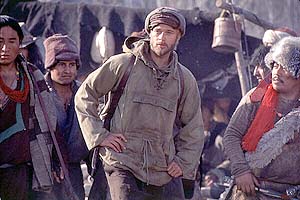
Since they began their tour 13 years ago, they've represented their culture in Western media, popping up in movie soundtracks and other collaborations. You may have heard their work in "Seven Years in Tibet," starring Brad Pitt, or in a score by Philip Glass for the Martin Scorsese film "Kundun."

Photo courtesy of friendsoftibet.org.
But in the end, nothing matches a live performance for sheer presence. "We find the audience very much engaged," said Rigzin. "They receive it in a very strong universal spirit."


E-mail: shih@northjersey.com

Copyright © 2007 North Jersey Media Group Inc.

Buddhist Opera Tech

Operatic fire and water
Friday, April 27, 2007
Photo courtesy of Lincoln Center

By EVELYN SHIH
STAFF WRITER

The Tristan Project, a new multimedia take on Richard Wagner's classic opera "Tristan und Isolde," has already debuted in Los Angeles and Paris. But at its New York debut, which hits Lincoln Center next week, the work will be at its most intense yet.That's all thanks to the Barco HD18 projector, a cutting-edge model that projects the work of video artist Bill Viola onto center stage. The technology used was unavailable at the time of the Los Angeles debut, upping the ante on clarity and visual impact.

But what does technology have to do with opera?

In this case, everything.

The Tristan Project began as a collaboration between Viola, Los Angeles Philharmonic conductor Esa-Pekka Salonen, and stage director Peter Sellars, who has a long-standing relationship with Lincoln Center. Sellars' spare directing spotlights Viola's art as a symbolic enactment of Wagner's magnum opus.
Photo courtesy of Lincoln Center
"They say about Beethoven that he wrote for a piano that did not yet exist. One could also say the same thing about Richard Wagner," said Jane Moss, Lincoln Center vice president of programming. Moss initiated the collaboration of the three artists and commissioned the work along with her counterparts at the Philharmonic and the Paris Opera.

"In a way, the new media developments realize his ideas about the ultimate transcendent fusion of theater and music, music and imagery," she said. "Wagner would be thrilled."

"Tristan and Isolde" is an Arthurian "Romeo and Juliet": Forbidden love leads the two young protagonists to their inevitable death. But Viola doesn't illustrate the convoluted plot so much as work through the themes with his carefully calibrated art.
One of his trademark devices is to slow images, stretching out a meticulously framed sequence to maximize the effect of his human subjects. For "Tristan," Viola uses elemental images of fire and water to match the famously grand music with a cosmic sense of Zen.

"It turned out to be the perfect collaboration and a perfect subject," said Moss, who was astonished when she heard that the three artistic collaborators picked a traditional opera like "Tristan" for their project. "There are so many aspects in the theme of 'Tristan and Isolde' that tap into the center of Bill Viola's work: transcendence, hope, transforming power of love, and spirituality. But he wouldn't have necessarily identified that opera as having that material in it."

Viola had never heard the opera when the collaboration began, but quickly identified the parallels between the 19th-century German music and the Buddhist qualities of his own work.
Photo courtesy of Lincoln Center.
As our ability to project intense, commanding images in the theater improves, will this become the wave of the future for opera performance?

"The word 'trend' is dangerous," warned Moss. "But the world of multimedia has exploded. Do I think some of those things are making their way into the world of theater?

"Yes," she said.

E-mail: shih@northjersey.com

Copyright © 2007 North Jersey Media Group Inc.

Wednesday, April 25, 2007

Alma's cooked water soup
Wednesday, April 25, 2007

Vegetarian recipes from recently released cookbooks:

"Lidia's Italy," by Lidia Matticchio Bastianich (Alfred A. Knopf, 2007)
Image courtesy of bn.com


After visiting old family homes, marketplaces and even country home kitchens, Lidia Matticchio Bastianich dishes up a gastronomic tour of her native Italy. Instructions for hand-made pastas and unusual vegetable combinations will be of interest to everyone, vegetarians included. Each regional chapter ends with an art history guide written by Bastianich's daughter Tanya Bastianich Manuali.

-- Evelyn Shih

* * *
Alma's cooked water soup

2 pounds swiss chard
1 onion, chopped (about 1 cup)
2 celery stalks, trimmed, peeled and cut into chunks (about 1½ cups)
1/3 cup fresh Italian parsley leaves
8 fresh basil leaves
1/3 cup extra-virgin olive oil
½ teaspoon peperoncino flakes, or to taste
1 tablespoon tomato paste
9 cups water
2 teaspoons salt, or to taste
¼ teaspoon freshly ground black pepper, or to taste
6 eggs
3 slices of day-old country bread, or 18 to 24 large croutons
Pecorino Romano cheese for serving

Image courtesy of e-rcps.com

Wash and drain the chard, and tear out the long stems from the leafy parts. Stack the leaves and slice crosswise into 1-inch strips. Cut off the rough base of each stem and discard. Chop the trimmed stems into ½-inch pieces.

Using a food processor, mince the onion, celery, parsley and basil into a fine-textured paste. Heat the oil in the sauce-pan over medium heat, scrape in the paste and stir it all around the pan as it starts to steam and sizzle. Sprinkle in the peperoncino and cook, stirring, until the paste has dried and starts to stick, about 4 minutes. Drop in the tomato paste, and stir to toast it for a minute.

Pour in 9 cups water, raise the heat to high, and stir up all the cooked seasonings, while adding 2 teaspoons of salt and some freshly ground pepper to taste. Bring the water to boil, and dump in all of the cut chard leaves and chopped stems. Return to a boil, cover partially, and simmer for about 40 minutes, until the chard is very tender and the broth is flavorful. Turn off the heat until you're ready to serve.

Ladle about 11/3 cups of soup per serving into the skillet. Heat to a simmer; crack and carefully slip into the soup one egg for each serving. Turn the heat down very low, cover the skillet tightly, and poach the eggs for 2 minutes or longer. Put a bread slice or croutons in each warm soup bowl and lay the egg and greens on the bread using a slot spoon or spatula. Ladle in hot broth to cover. Serve immediately with cheese.

Servings: 6.


Copyright © 2007 North Jersey Media Group Inc.

Sunday, April 22, 2007

B*TCHIN'

Culture evolves, foul words made fair
Sunday, April 22, 2007
Image courtesy of allposters.com


By EVELYN SHIH
STAFF WRITER

Two weeks ago, radio shock jock Don Imus let one of the most incendiary three-word insults in recent history slip through his lips: "nappy-headed hos."
Image courtesy of nytimes.com


That off-the-cuff remark – directed at the Rutgers women's basketball team and replayed ad nauseam – ignited a national debate on race, language, civility and sexism.

The Rev. DeForest "Buster" Soaries Jr. – who helped organize a meeting between Imus and the Rutgers team, at which the radio personality apologized – has called for a collective washing of the nation's dirty mouths, particularly entertainers who use sexist or harmful lyrics in their music. The Rev. Al Sharpton, Oprah Winfrey and an army of social and political critics are standing by with bars of soap.

"I think it's harming culture," said Marvin Sanders, co-host of a show on the conservative American Family radio network, of the off-color language permeating pop culture. "It's part of an ongoing degradation."

But what happens when loaded words shift in meaning, and their less offensive secondary meanings come into vogue? In recent years, once-taboo words like "ho," "bitch," "gay," "retarded" and "queer" have gained currency in the media and daily encounters, even as their original, hurtful meanings still resonate for some.
Image courtesy of cox.net.

When generational or cultural differences shift the sands of language, are the words or the people who speak them at fault?

A look at the recent popularity and widespread use of the word "bitch," a centuries-old semantic chameleon, offers some insight.

Since medieval times, the "B"-word has been used to insult cantankerous women, usually by other adults. In the past 25 years, though, the word has taken on new meanings and has gained a whole new base of users: tweens and teenagers.

Beyond being a noun for men and women, "bitch" is also commonly now used as a verb -- meaning, to complain -- and an in-group moniker among teens and even younger children when addressing friends.

Heard on radio and TV


"People my age say it," said Jasmine Jones, a 13-year-old eighth-grader at David E. Owens Middle School in New Milford. "They get the hang of it when they're younger. It's normal, I think, but there are parents and teachers who wouldn't want to hear kids saying it."

Image courtesy of reviewjournal.com

It helps that the "B"-word now regularly slips through television and radio censors, not the case a few decades ago. Central to the rhymes of rappers like Snoop Dogg and Missy Elliott, and even some mainstream pop hits, the word yawns out of radio stations and mouths across the nation in altered forms like "bee-yotch" and "biatch."

More recently, the catchphrase "Let's hug it out, bitch" from the HBO series "Entourage" legitimized it as a non-threatening, nearly intimate term of reconciliation or appreciation between men.
Image courtesy of houseofirony.com.

"There are two elements in slang that really make it popular," said lexicographer David Barnhart, a specialist in new words. "One is that it has shock value, and the other is that it has a hidden-meaning value. ... When people want to communicate with their peers and not with an older generation, they will develop a vocabulary. It has to do with exclusiveness."

Identity is all

Anyone can use the "B"-word, but the ability to use the word with impunity comes with identity, according to Barnhart and others. Though nuance matters, who you are may matter more.

But though Winfrey and others have championed stamping out words like "bitch" altogether, some women embrace the word as empowering. Case in point: the feminist Bitch magazine, which has hounded misogynist culture since 1996.
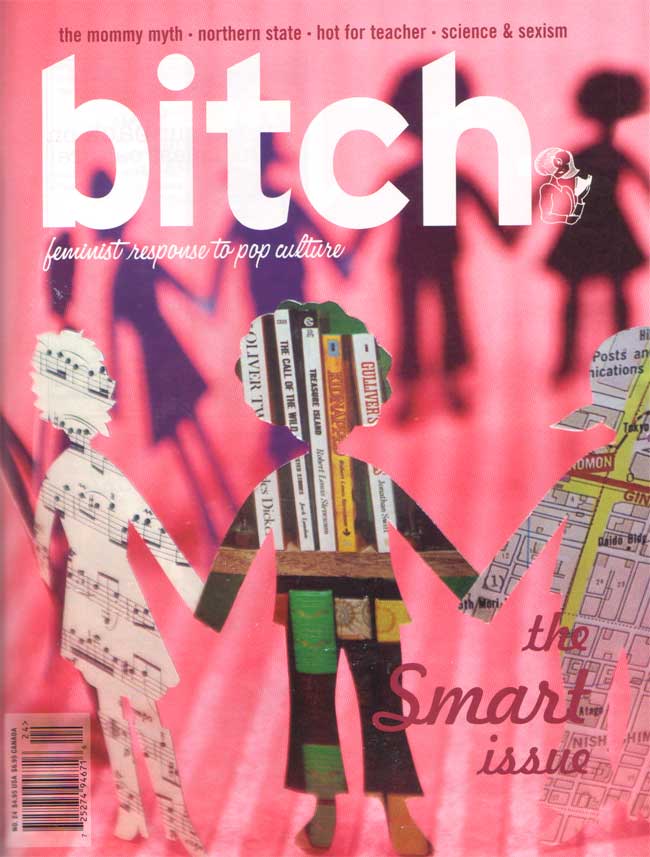
Image courtesy of bitchmagazine.com.

"There were never really any other names under consideration," said Andi Zeisler, co-founder and editor. "We felt 'bitch' was a word used for women who were speaking up, talking back or simply speaking their mind."

Despite this confidence, the magazine staff has had to deal with the controversy it sought to create. "We had women call up, really upset that after all they had done to stamp it out that we were bringing back the word," said Zeisler, the recent target of a boycott when she spoke at a Michigan college.

In her new book, "Pimps Up, Ho's Down: Hip Hop's Hold on Young Black Women," Vanderbilt professor T. Denean Sharpley-Whiting discusses female rappers like Lil' Kim and Foxy Brown, for whom the word "bitch" is not a stigma but a tattered badge of pride. Calling themselves "bitches" is a way of mouthing off to the Establishment and glorifying their sexual power, she said.

The dramatic 180-degree turn in the "B"-word's meaning may be surprising, but it's not new, according to Barnhart.

Six-century history
Image courtesy of answers.com.
First recorded usage of the word as insult took place around the year 1400, when "bitch" meant "a malicious, spiteful, promiscuous or otherwise pernicious woman, especially a prostitute," Barnhart said. By 1500, the word had crossed the gender line to mean "a despicable man," Barnhart said. Two hundred and twenty more years found the word being used to describe an infuriating object or situation, the probable genesis of "What a bitch!"

But in the mid-20th century, it began to mean "something surprising or extraordinary" and "something excellent, wonderful, exceptional and attractive."

All well and good. Yet despite these positive meanings, the one that persists, even among youth, is the original.

"Confronted with a woman in real life with that power and dominance, the reaction is still to be intimidated by her and to call her a 'bitch,' " remarked Zeisler.
Image courtesy of pearsonified.com.
And to assume that the word has entirely lost its rough edges would be naive, added Sharpley-Whiting. "They don't bleep it [on television] anymore, but that doesn't mean that it doesn't hurt," she said.

The same could be said for a list of other words and phrases that have gained more of a foothold in pop culture. The word "retarded," for example, has been largely shunned by polite society, including those who work with the mentally challenged, the preferred term.

Different definitions


In the past decade, however, entertainers and teenagers have begun using the word with more regularity in a variety of ways, including to mean being out of control (in good and bad ways), being severely intoxicated or inebriated, being silly or as a way of describing a melodic piece of music.

Image courtesy of artistopia.com.
In 2003, the pop group Black Eyed Peas released the song "Let's Get Retarded," a catchy party anthem that gained buzz. To gain more mainstream acceptance, however, the song's lyrics had to be changed to "Let's Get It Started," a minor recasting that led the image-conscious National Basketball Association to use the tune in its advertising.

Perhaps the only way to stop the spread of words like "bitch," "retarded" and "gay" in youth culture is to wait until the youth join civil society. Or maybe, as radio host Sanders advocates, never to use the words in the first place.

"I'm the kind of person that just says what he's thinking without a filter," said Sanders. "But I know nothing vile is ever going to come out of my mouth, because my mother used to wash my mouth out with soap if I did. I can still taste the soap."

E-mail: shih@northjersey.com

Copyright © 2007 North Jersey Media Group Inc.

Manga Kakumei! 漫画革命!

Sunday, April 22, 2007

By EVELYN SHIH
STAFF WRITER


# THE DARK GOODBYE: Volume 1, by Frank Marraffino and Drew Rausch; Tokyopop, 192 pages, $9.99.
# KING CITY: Volume 1, by Brandon Graham; Tokyopop, 192 pages, $9.99.


Manga may be a Japanese word, but the genre is no longer the sole providence of the Land of the Rising Sun. Tokyopop's new "global manga" push has resulted in a new crop of mangas that are made in the U.S.A.

"The Dark Goodbye" and "King City" are both American mangas rated for older teens.

The sci-fi "King City" transports us to a dystopian world with a style that combines the rounded touch of Japanese manga with American alternative comic quirkiness, bringing a dark edge.

Its main character, Joe the cat-master, goes on missions impossible for underground bosses by using his cat as a weapon and tool. The cat, when injected with "cat juice," morphs its parts into usable objects and copies keys in its gut.

Conspiracies threaten to destroy the world with evil magical forces, but Joe isn't trying to save it. Returning to his native King City, something of a ghost town, he's more concerned about his former flame Anna, who is in a relationship with a war veteran. "That girl used to put glue in her hair and jump on the bed and taste like grape candy. And how do you get over that?" muses Joe, staring at his own skater boy image in a bathroom mirror. In the end, it is what he will do to save her that makes him pull out the heroics -- and the cat's secret weapon.

"The Dark Goodbye," a noir horror manga, has a clearer hero in the chronically hung-over gumshoe Max Mason. Think "The Nightmare Before Christmas" meets "Dick Tracy" meets Japanese fantasy manga.

And that's before we meet the man-eating Venus flytraps, squid creatures 20,000 leagues above where they should be and a man whose body is composed of carnivorous insects. Why the monster menagerie? The city is "Los Allende," short for "Puerta a los Allende" -- "gateway to the other side."

Volume 1 is a contained episode in chapters, telling the story of the twins Lavinia and Mary Tillinghast (which is which?) and a powerful corporate family fighting an underground mob in a battle between good and evil (again: which is which?).

Now that's a question with global appeal.

Copyright © 2007 North Jersey Media Group Inc.

Wednesday, April 18, 2007

Buddha's Delight!

Buddha's delight (as cold salad)
Wednesday, April 18, 2007

Vegetarian recipes from recently released cookbooks:

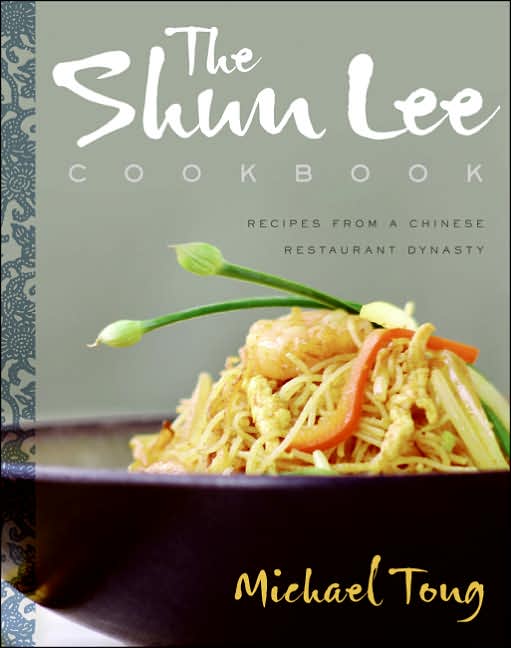
"The Shun Lee Cookbook," by Michael Tong (William Morrow, 2007)
Photo courtesy of bn.com

In 1965, Michael Tong and Tsung Ting Wang revolutionized Chinese food in America, re-introducing it as haute cuisine. Their restaurant, Shun Lee Dynasty, moved the menu beyond egg foo young and went on to earn multiple four-star ratings. Unfortunately, traditional Chinese banquet food means "big meat and big fish," and there are only a handful of vegetarian-friendly recipes in this book. Introductions to special techniques and uniquely Chinese materials, however, are useful for everyone. -- Evelyn Shih
* * *

Buddha's delight (as cold salad)

* 1 cup baby bok choy or bok choy hearts
* 1/3 cup bean sprouts, brown tips removed
* 4 slices peeled lotus root, cut crosswise to ¼ inch thickness
* ¼ cup canned gingko nuts, drained
* 1 cup trimmed sugar snap peas
* ¼ cup dried wood ear mushrooms, soaked in hot tap water until softened, drained, and torn in half
* ¼ cup canned straw mushrooms, drained
* ¼ cup dried lily buds, soaked in hot tap water until softened, drained
* 1/3 cup sliced water chestnuts
* ¼ of a small red bell pepper, seeds and ribs discarded, cut into strips about 1½ inches long and ¼ inch wide
* 2 tablespoons dark sesame oil
* 2 scallions, white part only, trimmed and sliced diagonally into ¼ inch pieces
* 6 large garlic cloves, peeled and sliced ޠinch thick
* 2 tablespoons soy sauce
* 1 tablespoon sugar
* 1 tablespoon Chinese black or balsamic vinegar

Bring a large saucepan of water to a boil over high heat. Add the bok choy and cook for 10 seconds. Then add the bean sprouts and lotus root, and cook for 5 seconds. Add the gingko nuts, sugar snap peas, mushrooms, dried lily buds, water chestnuts, and bell pepper. Return to a boil and cook for 1 minute. Drain in a colander. Run cold water over the vegetables for 3 minutes. Place the colander on a plate or bowl to catch the excess water, and refrigerate at least 30 minutes.

Heat a large wok over high heat. Add the sesame oil, then the scallions and garlic, and stir-fry just until the garlic is fragrant without turning brown, about 10 seconds. Transfer to a small bowl.

Place the chilled vegetables in a serving bowl. Add the sesame oil mixture to the vegetables. Combine the soy sauce, sugar, and vinegar in a small bowl, stirring to dissolve the sugar, and pour over the vegetables. Toss well, and serve immediately.

Servings: 4 to 6.

Copyright © 2007 North Jersey Media Group Inc.